St. Teresa of Avila
A Soulify guide to St. Teresa of Avila · Saints
Overview
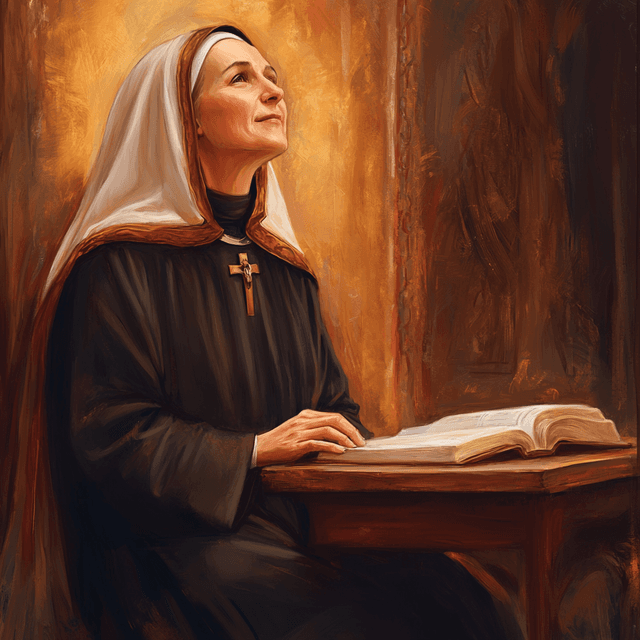
St. Teresa of Avila (1515-1582) stands as one of the Catholic Church's most influential mystics and religious reformers. A Spanish noblewoman who entered the Carmelite Order, she experienced profound mystical encounters with God that led her to reform the order and write seminal works on contemplative prayer. Her writings, including "The Interior Castle" and "The Way of Perfection," have deeply influenced Christian spirituality. Named the first female Doctor of the Church in 1970, St. Teresa exemplifies the perfect union of contemplative prayer and active service, demonstrating that the highest mystical experiences can coexist with practical organizational leadership.
Key Facts
- Feast Day:
- October 15
- Patron Of:
- Spain, religious, headache sufferers, writers, Catholic Renewal, contemplative life
- Born:
- March 28, 1515, Ávila, Spain
- Died:
- October 4, 1582, Alba de Tormes, Spain
- Attributes:
- Carmelite habit, book, quill, pierced heart, angel with golden arrow, dove
- Canonized:
- March 12, 1622, by Pope Gregory XV (declared Doctor of the Church in 1970 by Pope Paul VI)
Known For
- Developing the concept of mental prayer and describing the four stages of mystical prayer
- Founding the Discalced Carmelite Order, establishing 17 new convents dedicated to the original strict observance of Carmelite life
- Collaborating with St. John of the Cross in reforming the male Carmelite Order
- Writing major spiritual classics including "The Interior Castle," "The Way of Perfection," and her "Autobiography"
- Contributing significantly to the Counter-Reformation movement in 16th-century Spain
- Experiencing profound mystical phenomena, including the Transverberation of her heart
- Being the first woman declared a Doctor of the Church, alongside St. Catherine of Siena
Prayer & reflection with St. Teresa of Avila
O Saint Teresa, seraphic Virgin, beloved spouse of Christ, and our dear mother, look down from heaven and see the needs of Holy Mother Church, which you loved so dearly and for which you labored so valiantly. Help us with your powerful intercession to be true children of Mary and to grow in perfect love of God and neighbor. Teach us your way of perfection and help us to practice true reformation of life. Help us to experience in prayer that divine intimacy that you enjoyed so richly on earth and now enjoy eternally in heaven. Amen.
Miracles & tradition
Devotional accounts are presented as part of Christian tradition. Historical evidence and formal Church recognition vary by account.
The Levitation
During prayer, numerous witnesses reported seeing Teresa levitate, particularly during intense states of mystical rapture. These occurrences were well-documented and investigated during her canonization process.
The Healing of Her Nephew
One of her most famous miracles occurred when her nephew was crushed by a collapsing wall during construction work at one of her convents. Teresa took the seemingly lifeless child in her arms, prayed intensely, and restored him to full health and consciousness.
The Incorrupt Body
After her death, Teresa's body was found to be incorrupt, emanating a sweet fragrance. When her tomb was opened nine months after her burial, her body was found completely preserved and flexible, a phenomenon that continued for many years.
Legacy & Spiritual Impact
- Her concept of the "Interior Castle" has become a cornerstone of Catholic mystical theology, describing the soul's journey to union with God
- Her reforms of religious life influenced similar movements throughout the Catholic Church
- Her emphasis on combining contemplative prayer with active service remains a model for religious communities and lay people alike
- The Discalced Carmelite Order she founded continues to flourish worldwide, maintaining her emphasis on contemplative prayer and apostolic service
- Her practical wisdom about prayer and spiritual life continues to guide countless people in their spiritual journey
- Her writings revolutionized understanding of contemplative prayer and mystical theology, making complex spiritual concepts accessible to ordinary believers
- She pioneered a new understanding of feminine spirituality and leadership in the Church, paving the way for women's voices in theological discourse
The Soulify companion is an AI learning experience inspired by St. Teresa of Avila, not the historical person or an authoritative source of Church teaching.